Editor in chief:Sheng-Li SUN
International standard number:ISSN 1672-8785
Unified domestic issue:CN 31-1304/TN
Domestic postal code:4-290
- Most Read
- Most Cited
- Most Downloaded
2025, 46(11):2-10. DOI: 10.11972/j.issn.1672-8785.2025.11.001
Abstract:Currently, mass-producible passive daytime radiative cooling materials (including metamaterial films and coatings) with solar reflectivity exceeding 95% have been applied in various fields such as building thermal management and mitigation of the urban heat island effect. Previous studies have indicated that this type of technology can indirectly mitigate global warming by reducing anthropogenic greenhouse gas emissions associated with cooling energy consumption. However, quantitative research is lacking regarding the potential of large-scale radiative cooling technology to directly mitigate global warming by reducing Earth′s energy imbalance. To fill this research gap, this study aims to quantify the immediate impact of land-based large-scale radiative cooling technology on planetary albedo. Analysis shows that in most regions, the contribution of increased surface albedo to planetary albedo is significantly weakened due to the atmosphere′s shielding effect (reflection and absorption) of solar radiation reflected from the surface. Further quantitative analysis reveals that even large-cale deployment (e.g., covering 5% of the global land area) of daytime radiative cooling technology cannot directly and completely offset the currently observed trend of Earth′s energy imbalance.
2025, 46(11):11-12. DOI: 10.11972/j.issn.1672-8785.2025.11.002
Abstract:
ZHOU Xiao-xuan , LI Li-yuan , HU Zhuo-yue , RAO Peng , LIN Chang-qing , CHEN Fan-sheng , SUN Sheng-li
2025, 46(11):13-23. DOI: 10.11972/j.issn.1672-8785.2025.11.003
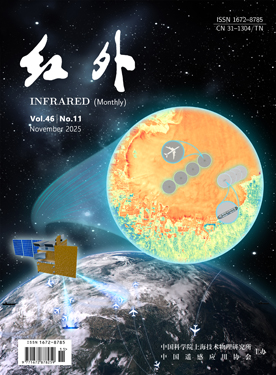
Abstract:The rapid development of artificial intelligence has significantly enhanced the potential for target detection and tracking, but the lack of high-quality dynamic infrared datasets has limited the target perception capabilities of space-based staring detection systems. This paper proposes a construction scheme that integrates remote sensing data with physical modeling to generate a multi-frame, three-band infrared dataset containing dynamic clouds, aircraft, and ships. The cloud motion vector fields are retrieved from high-temporal-resolution geostationary observations and mapped onto the high-resolution background of the SDGSAT-1 thermal infrared spectrometer (TIS) to generate dynamic cloud fields. Simultaneously, the motion trajectories and radiation characteristics of aircraft and ships are generated based on historical TIS observations and simulation models. This dataset can be used to train and evaluate target detection and tracking models and provides data support for infrared system performance evaluation.
CHEN Cheng , ZANG Chi , DENG Yan-chun , ZHANG Yi-xin , GE Jian
2025, 46(11):24-35. DOI: 10.11972/j.issn.1672-8785.2025.11.004
Abstract:The near- to mid-infrared wavelength range contains a wealth of astrophysical information and is crucial for studying cool stars, galaxy evolution, and small bodies in the Solar System. To overcome the limitations imposed by Earth′s atmosphere, such as absorption, scattering, and thermal noise, space-based infrared survey missions have become indispensable. Since the first all-sky infrared survey mission, Infrared Astronomical Satellite (IRAS), subsequent missions such as AKARI and Wide-field Infrared Survey Explorer (WISE) have accumulated massive datasets through wide-field observations, leading to breakthroughs in areas including brown dwarf census studies, active galactic nucleus identification, and measurements of asteroid physical properties. The recently launched Spectro-Photometer for the History of the Universe, Epoch of Reionization and Ices Explorer (SPHEREx) will carry out the first all-sky near-infrared spectroscopic survey and is expected to provide new insights into the large-scale structure of the Universe, the formation history of the Milky Way and external galaxies, the distribution of interstellar ices, as well as Solar System small bodies and exoplanetary systems. This article provides a systematic review of the development of near- to mid-infrared space surveys, with a particular focus on the scientific goals, achievements, and technical characteristics of the WISE and SPHEREx missions, and offers an outlook on future advances in this field.
LIU Ming , MA Zhecheng , LIU Heng , TIAN Zhi-yuan
2025, 46(11):36-63. DOI: 10.11972/j.issn.1672-8785.2025.11.005
Abstract:Ischemia-reperfusion injury (IRI) in different organs is a common pathophysiological basis in a variety of clinical critical diseases, such as myocardial infarction, cerebral stroke, and organ transplantation. The early diagnosis and real-time monitoring of IRI is unequivocally of great significance in revealing the underlying pathogenesis, evaluating tissue activity, and improving prognosis. Near-infrared (NIR) fluorescence imaging technology has displayed great potential in investigating IRI via the manner of in vivo real-time visualization. As the cornerstone involved in such a technology, fluorescent probes play a crucial role therein, and their design strategy and performance dominantly determine the imaging specificity, sensitivity, and evaluation ability. This minireview aims to outline recent advances in research dedicated to the diagnostic applications of NIR fluorescent probes via IRI imaging, with a focus on the pathophysiological mechanism of IRI and the key biomarkers that generally act as the basis of probe design. Additionally, we classify and summarize the imaging applications of fluorescent probes according to their involvement in various IRI models of important organs, including heart, brain, lung, liver, kidney, and limbs, and give an insight into the key to design rationale and imaging performance of the probes. Finally, we present a viewpoint towards the key challenges in NIR fluorescence imaging for mapping IRI and the future research regarding developing more versatile and more efficient NIR fluorescent probes for IRI clinical imaging applications.
2025, 46(11):64-81. DOI: 10.11972/j.issn.1672-8785.2025.11.006
Abstract:This paper reviews and summarizes the development history and technical characteristics of the infrared detectors for the Fengyun meteorological satellites, and looks forward to the development trend of infrared detectors. Since the successful launch of the Fengyun-1 satellite, China′s Fengyun satellite series has become an important part of the global meteorological observation system. As one of the core components of meteorological satellite payloads, the performance improvement of infrared detectors directly affects the accuracy and timeliness of meteorological forecasts. This paper first introduces the basic principles and key technologies of infrared detectors, then sorts out the evolution process of Fengyun meteorological satellites′ infrared detectors from the early stage to the latest version, including technological innovation, performance improvements, and scale expansion. At the same time, this paper also analyzes the current technical challenges and future development directions of infrared detectors, and discusses relevant technical pathways.
SHEN Yue , XIE Hao , WANG Xi , LI Xun , WEI Yan-feng , CHEN Lu , LIN Chun , YE Zhen-hua
2025, 46(11):82-93. DOI: 10.11972/j.issn.1672-8785.2025.11.007
Abstract:Very-long-wave infrared (VLWIR) detection plays an irreplaceable role in fields such as space remote sensing, deep space exploration, and infrared spectroscopy. HgCdTe is an ideal material for VLWIR detection due to its continuously tunable bandgap. However, managing the high dark current and ensuring material uniformity, both consequences of its extremely narrow bandgap, remain core challenges. This paper first reviews the research progress of VLWIR HgCdTe detectors and the evolution of international performance evaluation standards for HgCdTe detectors. Then, it analyzes the structural evolution and operating principle of mainstream devices. Finally, an outlook on the key technological challenges and future research directions for VLWIR HgCdTe detectors is presented.
Editor in chief:Sheng-Li SUN
International standard number:ISSN 1672-8785
Unified domestic issue:CN 31-1304/TN
Domestic postal code:4-290